
Offline Conversion Tracking in Google Ads: Feed Closed Deals Back Into Your Bidding
Published July 7, 2026
Offline conversion tracking sends closed deals from your CRM back to Google Ads so Smart Bidding can optimize for revenue instead of form fills.
Offline conversion tracking is the practice of sending conversions that happen away from your website (a qualified call, a booked appointment, a signed contract) from your CRM back into Google Ads, matched to the ad click that produced them. It exists because the conversion Google can see on its own, the form fill, is rarely the conversion you care about. This guide covers how the mechanics work, how we implement it for lead generation accounts, and what changes once your bidding can see revenue.
Why Form Fills Are a Weak Signal for Bidding
Most lead generation accounts are set up to optimize toward one event: the form submission. Someone clicks an ad, lands on a page, fills out a form, and Google Ads records a conversion. Smart Bidding then optimizes toward more people who resemble the ones who converted.
The problem is that form fills are not customers. In most lead-dependent businesses, a fraction of inquiries become qualified conversations, and a fraction of those become revenue. When you optimize toward form fills, Google optimizes toward the people most likely to submit a form. That group includes your best future customers, but it also includes price shoppers, job seekers, people outside your service area, and whatever bots got past your spam filters.
Accounts run this way plateau in a recognizable pattern. Cost per lead holds steady or even improves while the sales team reports that lead quality is slipping. Smart Bidding is doing exactly what it was told to do: buy form fills as cheaply as possible. Nobody told it that one of those leads was worth a $40,000 contract and another was worth nothing. From Google's side, the two conversions look identical.
You can't fix that with better ad copy or a tighter keyword list. The fix is giving the algorithm better data to optimize against.
What Offline Conversion Tracking Does
Offline conversion tracking imports conversion events from your CRM back into Google Ads. Instead of the conversion history ending at the form fill, Google also learns which clicks turned into qualified leads, which turned into opportunities, and which turned into closed revenue, along with a dollar value for each stage.
The mechanics rest on a simple idea. Google already tags every ad click with a unique identifier. If you store that identifier alongside the lead it produced, you can report back later: this click became a sales-qualified lead, that click became a customer worth $12,000, and those forty clicks went nowhere. Google matches each uploaded event to the original click and everything it knows about that click: the keyword, the ad, the device, the location, the time of day, the audience signals.
Once the loop is closed, Smart Bidding can weight its decisions by what your pipeline confirmed rather than treating every form fill as an equal win.
The Data Loop: From Click ID to Closed Deal and Back
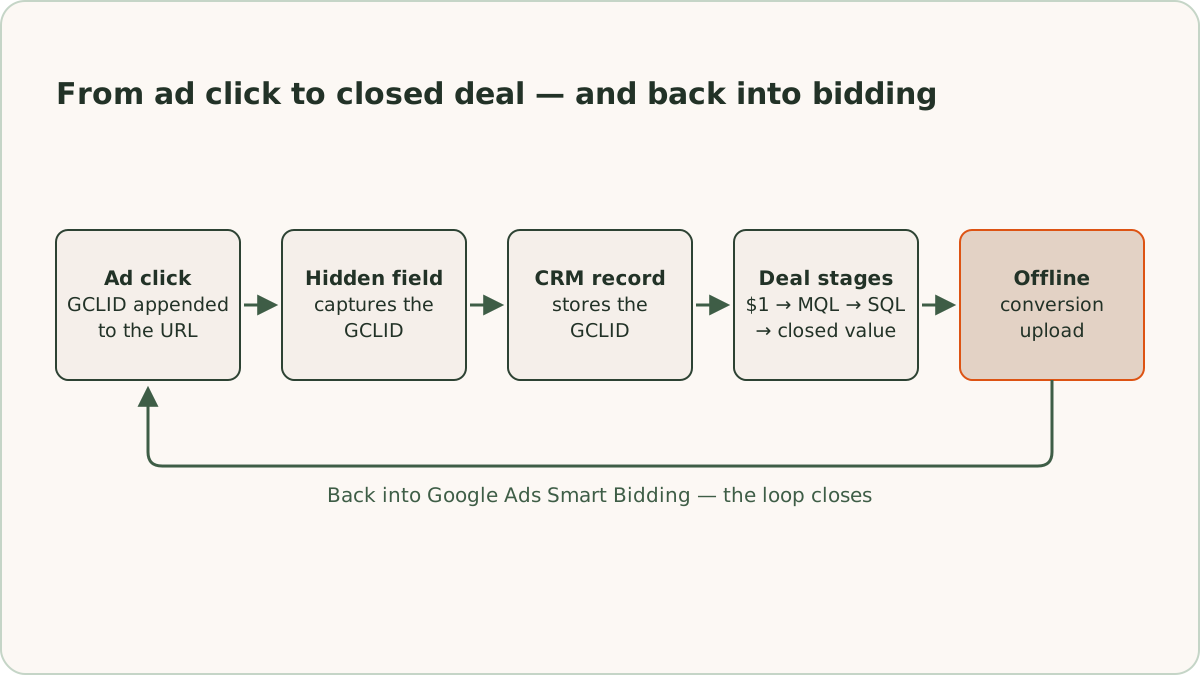
The system is a loop with three legs: capture the click ID when the lead comes in, carry it through the CRM as the lead advances, and upload staged conversion events back to Google. Any leg can break silently, so we treat each one as its own checklist.
Capturing the GCLID
The Google Click Identifier (GCLID) is a parameter Google appends to your landing page URL when someone clicks an ad, as long as auto-tagging is enabled in your account settings. It looks like ?gclid=CjwKCAjw... and typically runs 50 to 100 characters.
The standard capture method is a hidden form field. A small script reads the gclid parameter from the URL when the page loads, stores it, and drops it into a hidden input that submits along with the rest of the form. We also write the value to localStorage so it survives if the visitor browses several pages before converting. Some CRMs, including HubSpot and Pipedrive paired with certain form tools, offer native GCLID capture you can switch on instead.
Two details matter more than they look. The CRM field that stores the GCLID needs a character limit of at least 100, because a truncated GCLID will never match a click. And on multi-page journeys, the identifier has to persist from the landing page to wherever the form lives, which is what the localStorage step (or a first-party cookie set to match your attribution window) handles.
Carrying the Click ID Through the CRM
Capture is only half the job. The GCLID has to live on the record that moves through your pipeline, so that when a deal reaches a stage worth reporting, the click ID is sitting right there on it. Depending on the CRM, that means a custom field on the contact, the deal, or both, with a lookup step in the automation if the stage change happens on a record that doesn't hold the ID directly.
We set the GCLID field to read-only wherever the CRM allows it. A sales rep tidying up a record and clearing a field they don't recognize is a real failure mode, and it's invisible until conversions stop matching.
Enhanced Conversions for Leads, the Backup Path
GCLID capture fails in predictable ways: the visitor converts on a different device than the one they clicked on, a redirect strips the URL parameter, or someone forwards the page link to a colleague who becomes the lead. Enhanced conversions for leads is Google's answer to those gaps. Instead of matching on the click ID, you upload the lead's hashed email address or phone number, captured at the form, and Google matches it against signed-in user data to attribute the conversion to the right click.
We treat enhanced conversions for leads as a complement, not a replacement. GCLID matching is more precise when it works, and enhanced conversions recover a share of what it misses. Confirming that enhanced conversions is configured correctly rather than merely toggled on is part of our standard conversion tracking audit, alongside linking GA4 to the Ads account and making sure the right conversion goal is the account default.
Setting Up the Import: Our Implementation Pattern
On the Google Ads side, the setup lives under new conversion action, then Import, then "CRMs, files, or other data sources," tracking conversions from clicks. We create one conversion action per funnel stage we plan to upload, with descriptive names like "CRM - SQL" or "Deal Won," because every upload has to reference the conversion action name exactly and the match is case-sensitive. The click-through window defaults to 90 days, which fits most B2B and high-ticket sales cycles; if your CRM data says deals close faster or slower than that, match the window to reality.
Each action also gets a primary or secondary designation. Primary conversions feed Smart Bidding. Secondary conversions are recorded for observation only. This distinction does a lot of quiet damage when it's set wrong, so we're deliberate about it: qualified-lead and closed-deal stages are usually primary, intermediate bookkeeping stages are secondary.
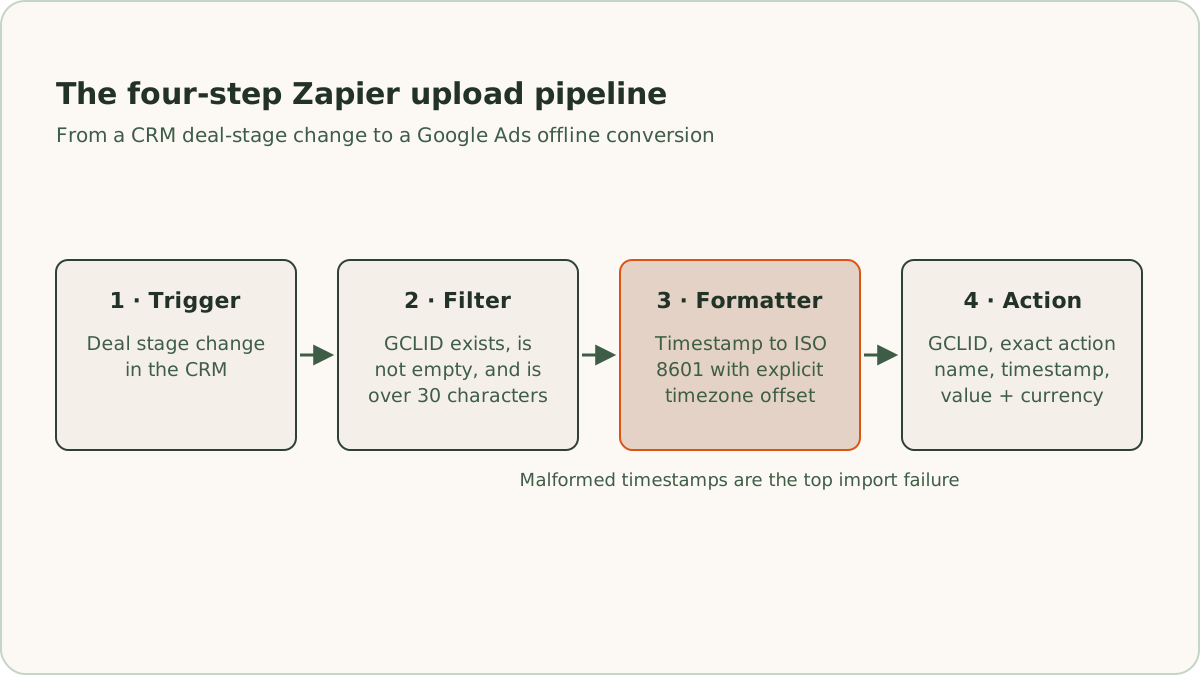
For the pipe between the CRM and Google Ads, we typically wire this with Zapier. The pattern is consistent regardless of the CRM behind it:
- Trigger: a deal or opportunity stage change in the CRM, filtered to the specific stage we're reporting.
- Filter: only continue if the GCLID field exists, is not empty, and is longer than 30 characters. This keeps junk and manually created records out of the upload.
- Formatter: convert the CRM timestamp to ISO 8601 with an explicit timezone offset that matches the Ads account timezone. Malformed timestamps are the most common reason imports fail.
- Action: upload the offline conversion with the GCLID, the exact conversion action name, the formatted timestamp, and the value and currency code when the stage carries one.
Then we test the whole loop end to end: click one of our own ads, submit a test lead, verify the GCLID landed in the CRM, advance the stage by hand, watch the automation run, and check the conversion diagnostics in Google Ads a day or two later. Google needs roughly 24 hours to process a click before it will accept a conversion against it, so an empty diagnostics screen on day one is normal.
Choosing Which Funnel Stages to Send Back
The tempting move is to upload only closed deals, since that's the outcome you care about. In practice it starves the system. Most lead gen accounts don't close enough deals per month to give Smart Bidding a usable signal, and a 60-day sales cycle means the feedback arrives two months late.
Our approach is progressive: we upload staged values that grow as the lead proves itself. A brand-new inquiry gets a nominal $1. Each qualification stage steps the value up, and when the deal closes we send the full contract value. The early signals give Google volume to learn from within days of the click, and the late signals teach it what pays. The staged values come from the same framework we use for lead scoring, so the numbers Google optimizes toward are the same numbers the sales team already agrees represent lead quality.
For businesses where contract values vary widely, we pass the actual deal value dynamically rather than a fixed number. For businesses without clean deal values, relative values still work: something like $10 for a marketing-qualified lead, $50 for a sales-qualified lead, and $500 for a win preserves the proportions even if the absolute figures are placeholders.
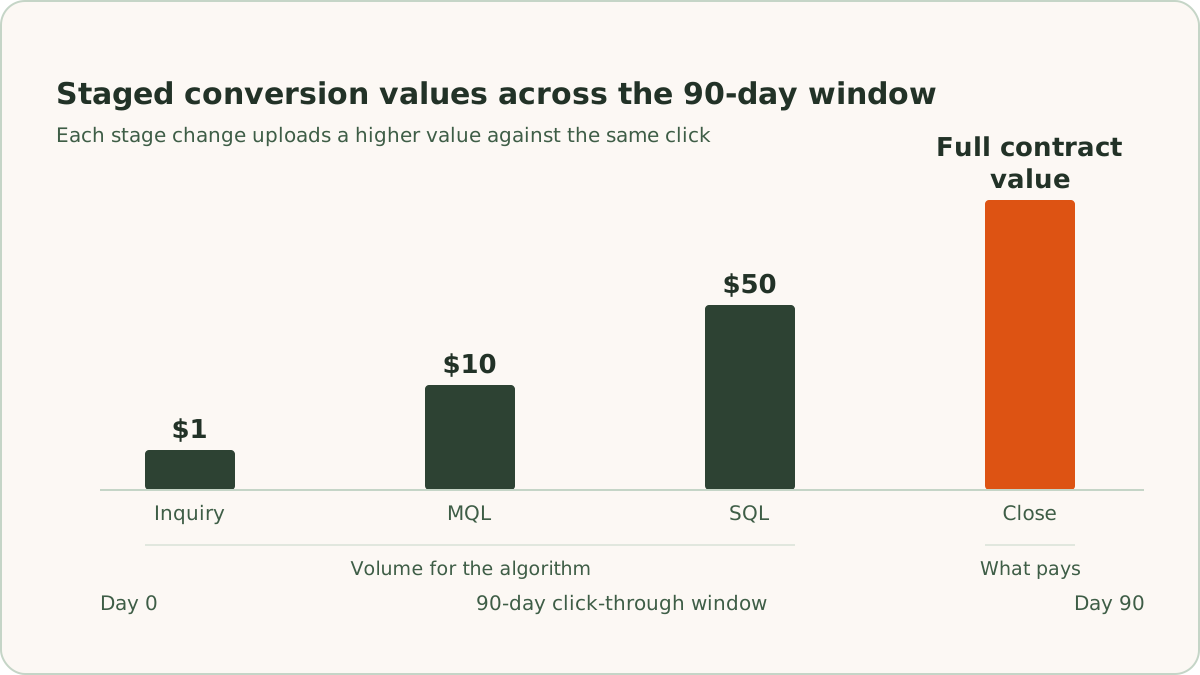
Everything gets uploaded within the click-through window. If a stage routinely happens more than 90 days after the click, either extend the window or accept that those conversions won't attribute.
What Changes Once Bidding Sees Revenue
The first change is strategic: with values attached to conversions, you can move from Maximize Conversions or target CPA to value-based strategies like Maximize Conversion Value or target ROAS. Bidding starts paying more for clicks that resemble past deal-producers and less for clicks that resemble past dead ends, across dimensions no human manages by hand: query phrasing, device, hour, location, audience membership, and combinations of all of them.
The second change shows up in your reporting, and it can look alarming if you're not ready for it. Cost per lead often rises after the switch, because the system is deliberately paying a premium for higher-intent clicks. What should fall is cost per qualified lead and cost per sale. Judge the change on those numbers, over a window long enough for your sales cycle to complete. We give bidding changes room to stabilize before reading them, and when a read is early we label it directional rather than calling a winner.
One boundary worth stating: offline conversion data improves the bidding side of the account, and only that side. What you pay per click is still governed by the auction, where Quality Score lowers your cost per lead through expected CTR, ad relevance, and landing page experience. The accounts that compound are the ones doing both: cheaper clicks from tight message match, better-chosen clicks from revenue-weighted bidding.
Common Setup Mistakes and How to Avoid Them
Most offline conversion problems trace back to a short list of causes. These are the ones we check first:
- Bad timestamps. The top cause of failed imports. Use ISO 8601 with an explicit timezone offset, make sure the conversion time is after the click time, and keep it inside the attribution window.
- Uploading too soon. Google needs about 24 hours to process a click. Conversions uploaded before that come back as "click not found" even when the GCLID is valid.
- Truncated GCLIDs. A field capped at 50 characters silently cuts identifiers that run longer, and every affected conversion fails to match. Give the field at least 100 characters.
- Name mismatches. The conversion action name in the upload must match Google Ads exactly, including case. "CRM - SQL" and "CRM-SQL" are different actions, and one of them doesn't exist.
- Duplicate uploads. Two automations firing on the same stage change, or a CRM workflow that loops, will double-count. Set the conversion count to "One" for lead gen and check the automation history when numbers look inflated.
- No ongoing monitoring. A broken Zap fails quietly. We review automation task history as part of our weekly account checklist, read the Google Ads conversion diagnostics monthly, and reconcile CRM totals against Google Ads quarterly.
The diagnostics screen under each conversion action tells you which failure you have: "click not found" points to capture or truncation problems, "outside attribution window" points to timing, and "invalid timestamp" points to formatting.
Close the Loop Before You Scale Spend
Offline conversion tracking is the difference between an account that gets efficient at buying form fills and an account that gets efficient at buying customers. Capture the GCLID at the form, carry it through the CRM, upload staged values as leads advance, and let bidding learn from revenue. It's plumbing work, and it's some of the highest-leverage work in a lead generation account, which is why it's a standard part of our Google Ads management for lead generation rather than an add-on. Across the $10.75M in ad spend we've managed over the last 12 months, the accounts with this loop in place are the ones where scaling budget scales revenue instead of noise.
Frequently Asked Questions
Quick answers to the questions readers ask most about this topic.
Offline conversion tracking sends conversions that happen away from your website, such as a qualified call, a booked appointment, or a signed contract, from your CRM back into Google Ads, matched to the ad click that produced them. It exists because the form fill Google sees on its own is rarely the conversion you care about, and Smart Bidding optimizes toward whatever conversions you feed it.
Through the GCLID, a unique identifier Google appends to your landing page URL when auto-tagging is enabled. A hidden form field captures it, the CRM stores it on the lead record in a field of at least 100 characters, and the upload references it. Google then matches the conversion to the original click and everything it knows about that click: the keyword, the ad, the device, the location, and the time of day.
No. Most lead gen accounts do not close enough deals per month to give Smart Bidding a usable signal, and a long sales cycle means the feedback arrives months late. Upload staged values instead: a nominal $1 at inquiry, values that step up at each qualification stage, and the full contract value at close. The early signals give Google volume to learn from within days of the click, and the late signals teach it what pays.
The most common cause is malformed timestamps: use ISO 8601 with an explicit timezone offset and make sure the conversion time falls after the click time. Other frequent causes are uploading before Google finishes its roughly 24-hour click processing, GCLIDs truncated by a short CRM field, and conversion action names that do not match Google Ads exactly, since the match is case-sensitive. The diagnostics screen under each conversion action tells you which failure you have.

Written by
Founder & CEO, ReClick.io
Corey runs Google Ads, landing page, and email nurture programs for lead generation businesses across the United States and Canada.
Keep Reading
Lead Generation Metrics: Every Number You Need to Track (and How to Calculate Each One)
The lead generation metrics that matter, from CPC to cost per SQL, each defined with its formula and one worked example carried through the full funnel.
Offline Conversion Tracking for Phone Calls: Stop Optimizing to Dial Clicks
Call tracking connects phone leads to the Google Ads clicks that produced them, so you can bid toward qualified conversations instead of dial clicks.
How Quality Score Lowers Your Cost Per Lead (the Mechanism, Step by Step)
Quality Score is a pricing input, not a report card. See how each component changes your actual CPC and how cheaper clicks flow through to lower cost per lead.