
Cost Per MQL: How to Calculate It and Why It Beats CPL for Budget Decisions
Published June 12, 2026
Cost per MQL divides ad spend by marketing qualified leads, not raw form fills. Here's how to calculate it and why it beats CPL for budget decisions.
Cost per MQL is what you pay in advertising to generate one marketing qualified lead. Divide ad spend by the number of MQLs it produced. The math takes ten seconds. The case for using it takes a little longer, because it rests on a flaw in the metric most lead generation businesses rely on instead. Cost per lead counts every form fill the same, whether it came from a buyer with budget and authority or from a student gathering quotes for a class project. Cost per MQL filters the junk out of the denominator before you divide.
The Problem With Making Budget Decisions on CPL
Cost per lead is total ad spend divided by total leads. It's easy to pull, easy to trend, and easy to compare across campaigns, which is why it shows up on nearly every dashboard we inherit. We covered the basics of the metric and where it fits separately. In short: CPL is a fine efficiency metric and a poor decision metric.
The problem is the denominator. "Leads" includes everyone who filled out the form. Buyers with a real project and a budget count as one lead. So do job applicants, existing customers looking for support, competitors doing research, and bots that slipped past the filters. CPL treats all of them as equal output.
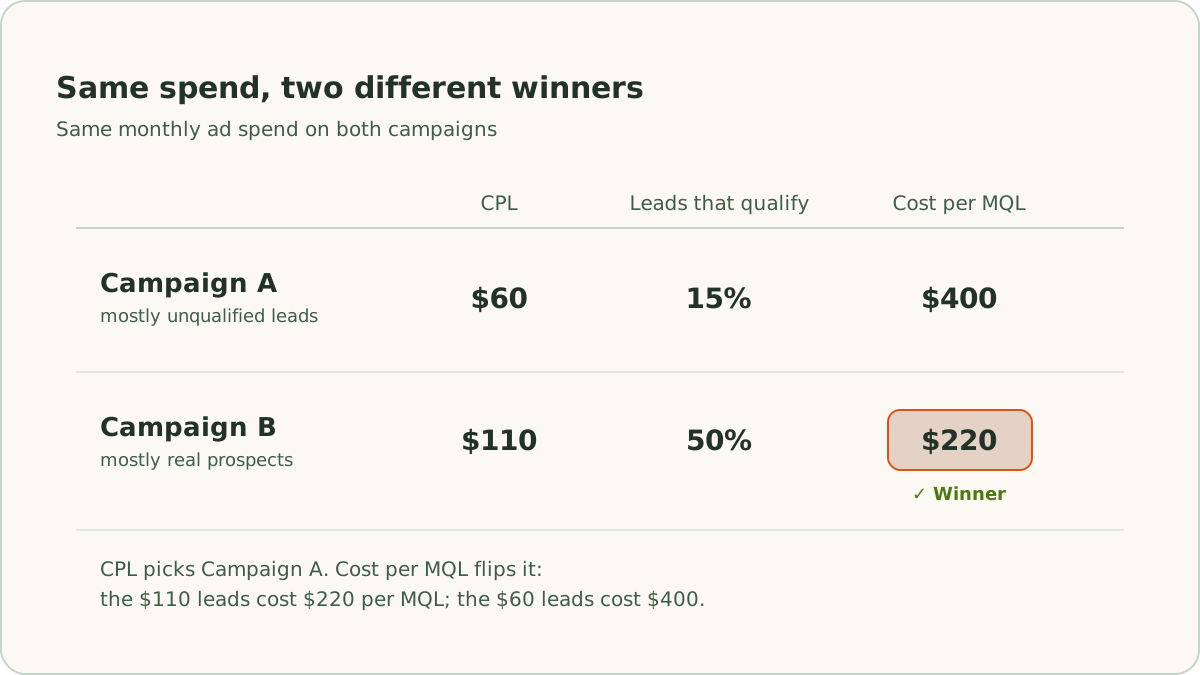
That distortion gets expensive when you use CPL to allocate budget. Say Campaign A produces leads at $60 and Campaign B produces leads at $110. On a CPL report, A wins and gets the next budget increase. But if A's leads are mostly unqualified and B's leads are mostly people your sales team wants to talk to, the report pointed you in the wrong direction. You'd be scaling the campaign that generates activity and starving the one that generates revenue. We see this pattern regularly in accounts we take over: the "cheap" campaign that looks best on the dashboard is often the one attracting the lowest-intent clicks, because low-intent clicks are cheaper to buy.
What Cost Per MQL Measures Instead
A marketing qualified lead is a lead that has passed your qualification bar: right company profile, real project, working contact information, whatever criteria you and your sales team have agreed define "worth pursuing." Cost per MQL (cost per marketing qualified lead) is your ad spend divided by the number of leads that cleared that bar.
The change sounds small. In practice it reorders your priorities. A campaign's cost per MQL reflects both what you paid for clicks and what fraction of the resulting leads were real, so a campaign can't buy its way to a good number with cheap junk. Expensive clicks that qualify at a high rate will beat cheap clicks that don't, and cost per MQL makes that visible.
The Cost Per MQL Formula
Cost per MQL = total ad spend / number of MQLs generated by that spend.
Two practical notes on running the calculation.
First, match the spend to the leads it produced, not to the calendar. Leads often take days or weeks to qualify, so the MQLs marked in your CRM this month may trace back to clicks you paid for last month. Cohort by lead creation date: take the leads created in a period, count how many of them eventually became MQLs, and divide that period's spend by that count. If you divide this month's spend by this month's qualifications, a slow qualification process will make good months look bad and bad months look good.
Second, segment before you average. A blended, account-wide cost per MQL is a health check. The useful version is cost per MQL by campaign, and for your biggest campaigns, by ad group. Budget decisions happen at that level.
Worked Example: Same Spend, Different Story
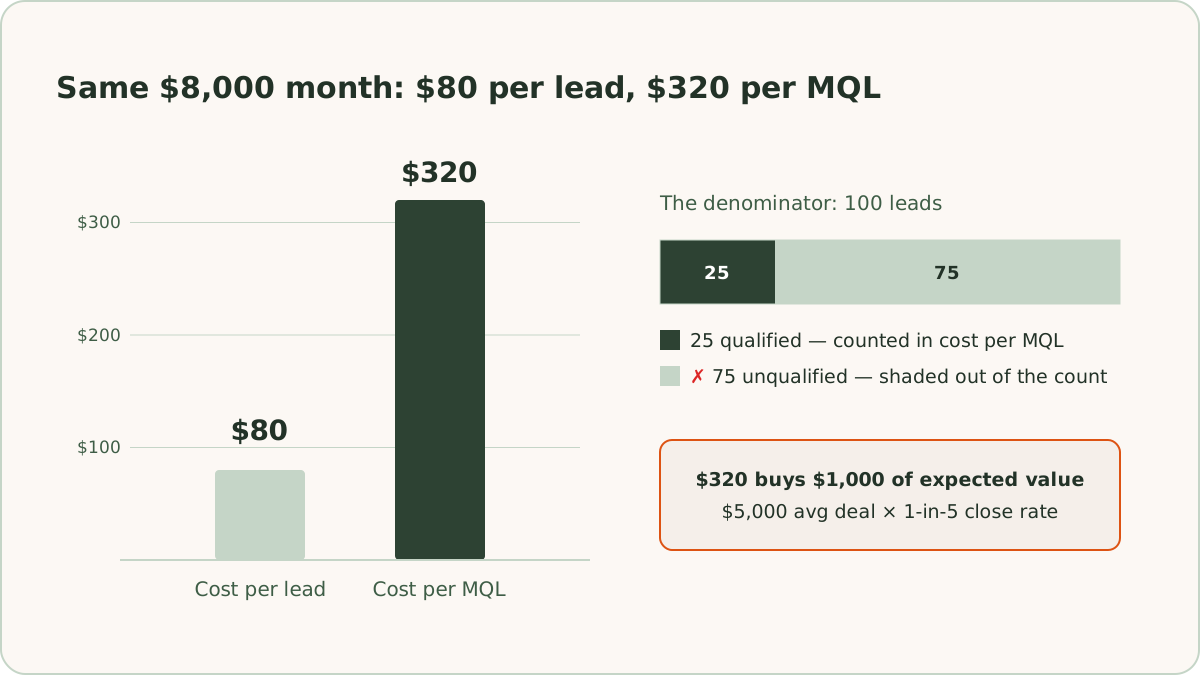
You spend $8,000 in a month and generate 100 leads. Cost per lead: $80. Your sales team reviews the leads and accepts 25 as qualified. Cost per MQL: $8,000 / 25 = $320.
Both numbers are true. Only one of them tells you what a real prospect costs. If your average deal is worth $5,000 and you close one in five MQLs, you're paying $320 for something with an expected value of $1,000, and the account deserves more budget. The $80 figure can't support that reasoning, because 75 of the 100 things it counted were never going to buy anything. You can run your own numbers through our cost per lead calculator to see both metrics side by side.
The example also shows where the leverage is. Suppose nothing changes in the ad account, but you add an email and SMS nurture sequence that follows up with the 75 leads that didn't qualify on first contact. Some of them were real buyers who weren't ready yet. If nurture converts ten of them into MQLs over the following weeks, you now have 35 MQLs from the same $8,000, and cost per MQL drops from $320 to about $229. That's a roughly 29 percent improvement with zero changes to bids, keywords, or ads. This is why we run nurture as part of the same system as the ad account rather than as a separate project: the follow-up process is a direct input to the metric you're buying media against.
What You Need in Place to Calculate It
Cost per MQL fails in practice for two reasons: nobody agreed on what an MQL is, or nobody can trace an MQL back to the spend that produced it. Both are fixable.
A Working MQL Definition
The definition has to be written down, agreed on with sales, and applied consistently. "Marketing thought it looked good" is not a definition. Criteria like company size, service area, project type, and contact validity are. If the bar moves month to month, the metric moves with it and stops meaning anything.
We handle this with progressive lead scoring rather than a single yes/no gate. A lead is worth $1 at first inquiry, and its value steps up as it clears each stage, all the way to full contract value when a deal closes. The MQL threshold is one rung on that ladder. If you're building your first scoring model, start with our guide to lead scoring.
Lead Source Tracking From Ad to CRM
To compute cost per MQL by campaign, every lead record in your CRM needs to carry the identity of the click that created it. In Google Ads that means capturing the GCLID, the unique click identifier Google appends to your landing page URLs when auto-tagging is enabled.
Our standard implementation is a hidden form field. The landing page reads the gclid parameter from the URL, stores it in localStorage or a first-party cookie so it survives multi-page visits, and writes it into a hidden input that submits with the form. The CRM stores it in a dedicated field of at least 100 characters, because GCLIDs run 50 to 100 characters and a truncated one is useless. Some CRMs capture this natively; most need the hidden-field approach. Either way, the test is simple: click your own ad, submit a test lead, and confirm the GCLID lands intact on the CRM record.
Getting MQL Data Back Into Google Ads
Calculating cost per MQL in a spreadsheet is step one. The bigger win is feeding qualification data back into Google Ads as offline conversions, so Smart Bidding optimizes toward qualified leads instead of raw form fills.
The mechanics: create an import-type conversion action in Google Ads for the MQL stage. When a lead is marked qualified in the CRM, an automation (we use Zapier on most accounts) sends the stored GCLID, the conversion time, and a conversion value back to Google Ads. Google matches the GCLID to the original click, and the conversion is credited to the exact campaign, ad group, and keyword that produced it. We upload these across a 90-day click-through window, which covers the qualification lag on most lead gen sales cycles.
A few implementation details matter more than the rest. Conversion timestamps have to be in a consistent format with the correct timezone, and the conversion time has to fall after the click; malformed timestamps are the most common reason imports fail. Uploads should wait at least 24 hours after the click so Google has finished processing it. The MQL conversion action should be set as primary so bidding uses it, with later stages tracked as secondary until you have enough volume to bid on them. Once the feed is live, the Diagnostics tab on the conversion action tells you whether uploads are matching clicks.
The payoff shows up in two places. Inside Google Ads, you can add the MQL conversion column to any report and read cost per MQL by campaign, ad group, or keyword directly, no spreadsheet required. And over time, Smart Bidding starts finding more of the clicks that qualify, because it finally has data on which leads qualified.
Using Cost Per MQL to Reallocate Budget
Once cost per MQL is visible by campaign, budget decisions get plainer. Shift spend toward the campaigns with the lowest cost per MQL and away from the ones whose cheap leads never qualify. Pause or rebuild the segments where qualification rates sit near zero, because that traffic was never worth buying at any CPL.
Two cautions from our own practice. MQL counts are smaller than lead counts, so the numbers are noisier. A campaign with four MQLs this month and seven last month has not "gotten 43 percent worse"; it has a small sample. We hold reallocation decisions until the read is stable across enough volume, and when we act on an unstable read anyway, we label the decision as directional and size it accordingly. Second, attribution deserves a glance before you cut anything. Standard conversion columns credit the last click, which flatters bottom-of-funnel campaigns like branded search and undercounts the campaigns that introduced the buyer in the first place. Before pulling budget from a top-of-funnel campaign with a high cost per MQL, check its assisted conversions. A campaign that rarely closes but frequently starts the conversion path is doing work the last-click number hides.
Going One Level Deeper: Cost Per SQL and Cost Per Opportunity
The same arithmetic extends down the funnel. Cost per SQL is spend divided by sales qualified leads. Cost per opportunity divides by opportunities created, and cost per acquisition divides by closed deals. On accounts with the tracking in place, we set up separate offline conversion actions for each stage, so all of these are readable inside Google Ads alongside cost per MQL.
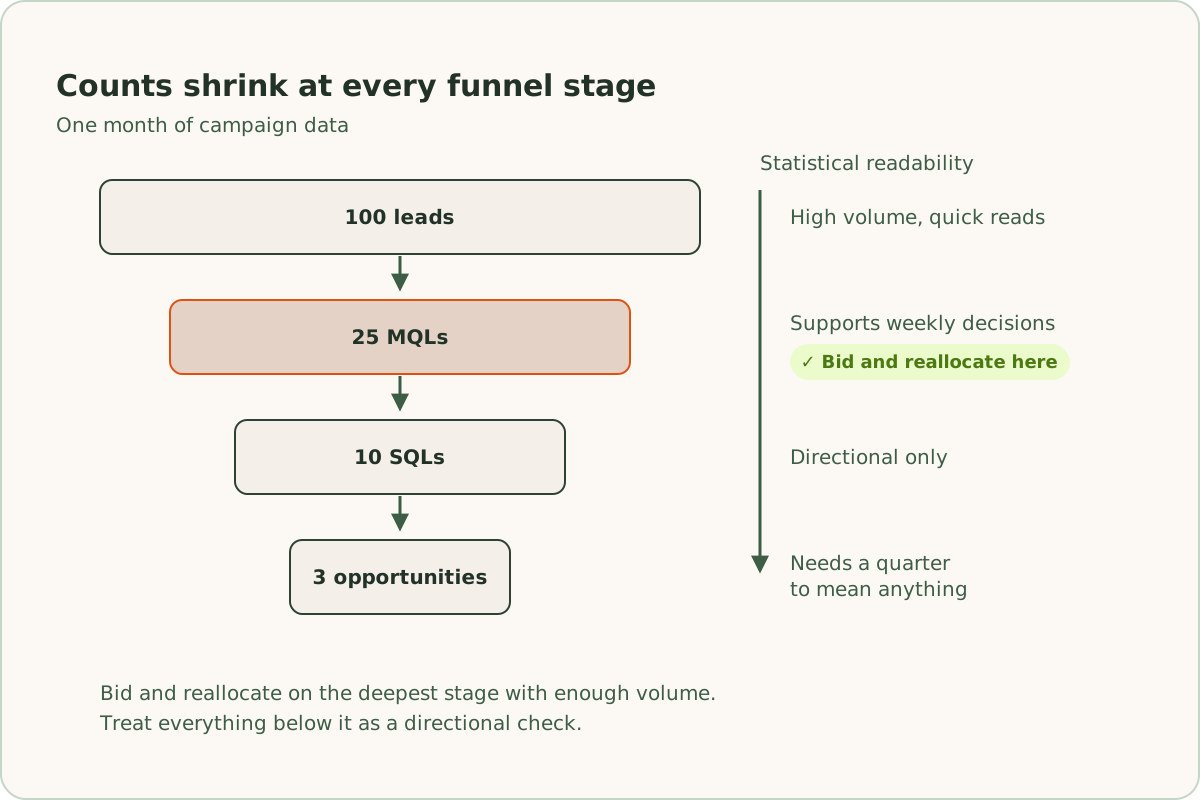
Each step down the funnel gets you closer to revenue and further from statistical comfort, because the counts shrink at every stage. A campaign might produce 100 leads, 25 MQLs, 10 SQLs, and 3 opportunities in a month. The MQL number supports weekly decisions; the opportunity number might need a quarter to mean anything. Our working rule: bid and reallocate on the deepest stage that still has enough volume to read, and treat everything below it as a directional check. If the line between the MQL and SQL stages is fuzzy in your organization, MQL vs SQL covers where to draw it and who owns each side.
Put Cost Per MQL in Charge of the Budget
CPL tells you what a form fill costs. Cost per MQL tells you what a prospect costs, and prospects are what you're buying. Getting there takes a written qualification bar, GCLID capture into your CRM, and an offline conversion feed back into Google Ads. Building that system (ads, dedicated landing pages, and nurture working from the same data) is the core of our Google Ads management for lead generation. We've generated 5,000+ leads for 35+ lead generation businesses this way, and cost per MQL, not CPL, is the number we manage those accounts to.
Frequently Asked Questions
Quick answers to the questions readers ask most about this topic.
Cost per MQL is what you pay in advertising to generate one marketing qualified lead: ad spend divided by the number of leads that cleared your qualification bar. Unlike cost per lead, it filters job applicants, competitors, bots, and other junk out of the denominator before you divide, so a campaign cannot buy its way to a good number with cheap unqualified clicks.
Divide total ad spend by the number of MQLs that spend produced. If you spent $8,000, generated 100 leads, and sales accepted 25 as qualified, your cost per MQL is $320. Cohort by lead creation date rather than the calendar, because leads often qualify weeks after the click, and segment by campaign before you average, because budget decisions happen at that level.
CPL counts every form fill the same, so a campaign producing cheap unqualified leads can look better than one producing real prospects. Cost per MQL reflects both what you paid for clicks and what fraction of the resulting leads were real, which means expensive clicks that qualify at a high rate beat cheap clicks that never do. That is the comparison a budget decision needs.
Capture the GCLID, the click identifier Google appends to your landing page URLs, in a hidden form field and store it on the lead record in your CRM. When a lead is marked qualified, an automation sends the GCLID, the conversion time, and a value back to Google Ads as an offline conversion, and Google credits it to the exact campaign, ad group, and keyword that produced the click.

Written by
Founder & CEO, ReClick.io
Corey runs Google Ads, landing page, and email nurture programs for lead generation businesses across the United States and Canada.
Keep Reading
Lead Generation Metrics: Every Number You Need to Track (and How to Calculate Each One)
The lead generation metrics that matter, from CPC to cost per SQL, each defined with its formula and one worked example carried through the full funnel.
Offline Conversion Tracking for Phone Calls: Stop Optimizing to Dial Clicks
Call tracking connects phone leads to the Google Ads clicks that produced them, so you can bid toward qualified conversations instead of dial clicks.
Offline Conversion Tracking in Google Ads: Feed Closed Deals Back Into Your Bidding
Offline conversion tracking sends closed deals from your CRM back to Google Ads so Smart Bidding can optimize for revenue instead of form fills.