
Scaling Google Ads from $10K to $140K a Month for a National Lemon Law Firm
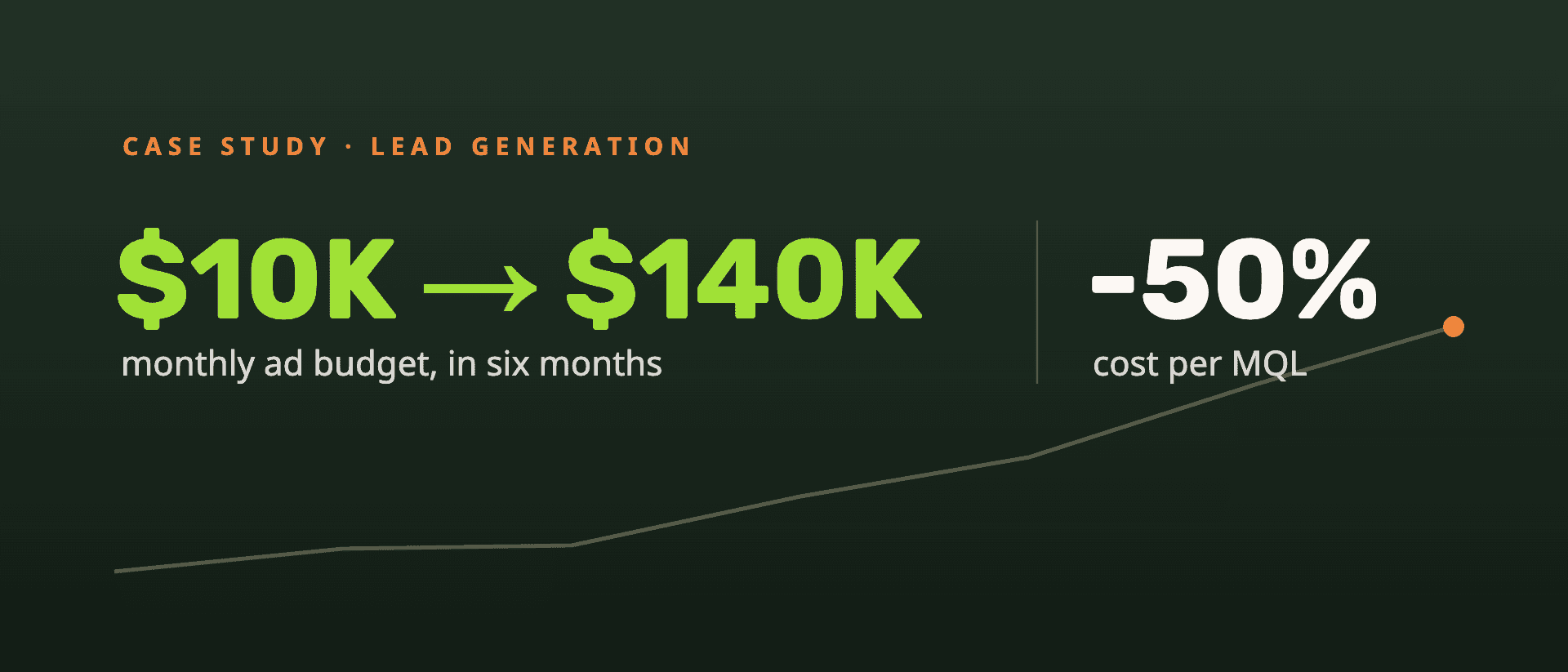
How we scaled a national lemon law firm's Google Ads budget from $10K to $140K a month in six months while cutting cost per MQL in half by bidding on CRM outcomes instead of form fills.
Overview
The client is a national lemon law firm representing drivers whose defective vehicles qualify for refunds, replacements, or cash settlements under state lemon laws. The firm operates nationally, runs a high-volume intake operation, and measures its marketing on one number: cost per marketing qualified lead, with a $300 target.
When we took over the account in February 2026, it was new and struggling. January had produced roughly 650 form submissions but only about 35 MQLs, at a cost per MQL roughly double the target. The account was bidding on raw form fills, a $1-value event in this category, so Google's algorithm was doing exactly what it was told: buying cheap, unqualified volume. A list of 1,600 negative keywords sat in the account but had never been properly applied, so budget was leaking into searches about old vehicles, DIY car troubleshooting, and accident claims that could never become cases.
Six months later the account is a different operation. July 2026 was its best month to date, with cost per MQL down 50% from February and under the client's target for the first time. The most recent four weeks produced more than 400 MQLs. Monthly Google Ads budgets have scaled from $10,000 in February to $140,000 in August, with another $10,000 to $15,000 a month running on Microsoft Ads (Bing). The client is funding the increases because cost per MQL has held while volume compounds. Since February the account has produced over 1,400 marketing qualified leads.
The Challenge
The inherited state had four problems, all pulling in the same direction.
- The bidding target was wrong. The account optimized on form submissions, which in lemon law are mostly noise. Only about 5% of January's form fills became qualified leads, and the algorithm had no signal telling it which clicks produced the other 95%.
- Cost per MQL was double the target. Roughly twice the client's $300 goal, on a starting budget of $10,000 a month that the client wanted to scale well past.
- Negative keywords existed but weren't working. Around 1,600 imported terms sat unapplied while ads served against wrong vehicle years, troubleshooting searches, and unrelated legal intent.
- The structure was generic. Broad head terms carried most of the spend in a single national campaign, with no separation by vehicle make, state, or intent tier, and no way to fund the pockets that converted well.
Our Approach: Bid on the CRM, Structure Around Cheap MQLs, Test Everything
1. Point the bidding at the CRM, not the form
The first structural move was making the qualified lead, not the form fill, the thing Google optimizes for. Every ad click is tagged and followed into the client's CRM, and stage changes are pushed back into Google Ads as offline conversions with escalating values attached, from first inquiry through qualified lead to signed client. Intake at a law firm runs heavily by phone, so the same loop covers calls: qualified phone conversations are matched back to the clicks that produced them and uploaded alongside the form leads. We've written up both halves of that system in our guides to offline conversion tracking for form fills and offline conversion tracking for phone calls.
In March we switched the core campaigns to value-based bidding against those weighted values. In the six weeks after the switch, cost per MQL improved by more than half and MQL volume grew more than sixfold. Total tracked conversions fell at the same time, because Google Ads stopped optimizing on $1 form fills. That was expected: we were trading cheap form fills for qualified claimants.
In June we tightened the signal further by removing form fills and phone calls from the core search campaigns' conversion goals entirely, leaving only MQLs and converted leads. We ran that change in parallel with a bid-strategy change on Performance Max as a deliberate two-campaign comparison, and the signal cleanup was the stronger lever: it steadied cost per MQL and lifted the click-to-MQL conversion rate, while the bid-strategy change alone did neither cleanly. Signal quality beat bid mechanics, and that finding now shapes how we sequence changes on every lead gen account we run.
2. Structure spend around where MQLs are cheap
With the bidding pointed at the right outcome, the second workstream was finding the pockets of the auction where qualified leads cost the least, and building campaign structure that lets us fund them directly.
Vehicle makes came first. Searches that name a specific make carry pre-filtered intent that broad head terms don't. We broke the strongest high-intent vehicle-make segment into its own dedicated campaign in late April, and when it held efficient, extended the same structure to additional make segments through May and June as their dedicated landing pages arrived.
Geography came second. A six-month state-level analysis found the account's blended cost per MQL masked a wide spread between the most efficient states and the weakest, and that a handful of states converted 3 to 5x more efficiently through Search than through Performance Max. We excluded those states from Performance Max so their spend flows through the channel that converts them, and left Performance Max concentrated where it holds the structural advantage. Then we went a step further: states converting well under the account average were being starved inside the national campaign, so we launched a dedicated campaign for the strongest of them in late July, with a second state following in early August on the same logic.
The auction data confirmed the structure was compounding. Non-brand impression share grew from 10% in February to 27% in May, and the account's competitive position in the auction improved over the same period.
3. Run the account as a sequence of measured experiments
Every meaningful change on this account runs as a documented experiment with a hypothesis, a read date, and a decision, and the failed tests get closed as fast as the wins get scaled.
A manual bidding test in February ended after three weeks when cost per MQL ran too high. A test in May improved clickthrough exactly as hypothesized, but the broader queries it pulled in diluted intent and conversion rate fell, so we closed it early rather than let the drag run. Ad-schedule testing separated the days that convert at account-average economics from the one that ran at more than double it, so we paused narrowly rather than broadly, then later reopened a limited window when the data suggested the full pause was pushing Google Ads into more expensive adjacent inventory. Landing page variants ran as A/B tests against the control, and the control's win was documented with the same rigor as any other result.
No single change here is dramatic. Together they are why the client kept approving budget increases: each step up followed evidence, and each test that failed was caught before it could compound.
The Scaling Arc: February to August
February and March: foundation. The budget started at $10,000 a month while we rebuilt the negative keyword system, consolidating the 1,600 unapplied terms into organized, categorized shared lists, cleaned up the structure, and made the switch to value-based bidding. Over our first eight weeks the account produced 100 MQLs at just under $400 each.
April and May: structure. Budgets moved to $35,000, then $60,000. The first dedicated vehicle-make campaigns launched, the state-level and auction analyses landed, and the Performance Max geography exclusions went in. The eight weeks ending in late May produced nearly four times the MQL volume of the prior eight weeks, at a cost per MQL more than 30% lower.
June: discipline. A $75,000 budget. The client's objective shifted from pure scale to predictable, scalable MQL acquisition, and June's changes matched it: the conversion-goal cleanup on the core search campaigns, a tighter bidding framework on Performance Max, and an ad-asset refresh driven by a quality audit.
July: the best month yet. A $120,000 budget and the account's best month to date: cost per MQL down 50% from February and under the $300 target for the first time, with spend up roughly 50% over June at roughly 20% better efficiency.
August: continued scale. A $140,000 Google Ads budget plus $10,000 to $15,000 a month on Microsoft Ads (Bing), the first two dedicated state campaigns live, and Performance Max budgets stepped up alongside. The client's intake side is seeing the quality flow through: on a recent call they reported over 90% of pre-qualified leads converting to document collection, against a historical norm of 35 to 45%.
Key Wins & Strategic Insights
- Optimize the number the business pays for. Cost per MQL, not cost per form fill, is the metric this firm runs on. Rebuilding the bidding around CRM-verified qualified leads cut cost per MQL by more than half in the first six weeks after the switch and is the foundation every later gain sits on.
- Signal quality beat bid strategy. When we tested conversion-goal cleanup against a bid-strategy change across two campaigns simultaneously, the cleaner signal won. Feeding the algorithm fewer, better conversions moved cost stability more than changing how it bids.
- Pre-filtered intent is the scaling lever. Make-specific campaigns and state-specific campaigns both work for the same reason: the query or the geography arrives already qualified, so budget concentrates on clicks with a structurally higher chance of becoming an MQL.
- Fast kills protect the budget. The manual bidding test, the clickthrough test that diluted intent, and the losing landing page variant were each closed within weeks of the data turning. An account scaling this fast cannot afford to let losing tests linger.
- Scale and efficiency moved together. The monthly budget grew from $10K to $140K on Google Ads, with another $10K to $15K a month on Bing, while cost per MQL fell by half. We fixed the signal first, restructured spend second, and raised budgets last.
What We Learned
Lead gen accounts scale on the quality of their conversion signal, not the size of their budget. Moving the firm's bidding onto CRM-verified qualified leads, then structuring campaigns around the makes and states where those leads are cheapest, let the monthly budget grow from $10K to $140K in six months while cost per MQL fell by half. Every budget increase followed evidence, and every losing test was closed before it could compound.
Where The Account Goes Next
The playbook now shifts from aggressive moves to compounding optimizations. The state campaign roster grows as each new state proves out, with the first two state campaigns as the template. The landing page test running in Performance Max reads soon and will inform the next page version. And the client's video library opens a YouTube channel test, extending the account into inventory it has not yet touched. The efficiency bar stays where it has been all along: qualified leads under $300, verified in the CRM, at whatever scale the auction will support.
Ready to lower your cost per qualified lead?
We help lead gen businesses build Google Ads accounts where the bidding optimizes on CRM-verified outcomes, not form fills, and where every budget increase follows evidence. If your account produces plenty of leads but your cost per qualified lead is a mystery, we can fix that.
Book a strategy call • See our full methodology • How we work with law firms
Frequently Asked Questions
Common questions about B2B Google Ads, long sales cycles, and offline conversion tracking.
It works when the account is optimized against the lead stage the firm values. Lemon law generates enormous form-fill volume, and most of it never qualifies: a vehicle is too old, the claim is out of state, the defect doesn't meet the statute. When we took over this account, it had produced roughly 650 form submissions in a month that turned into only about 35 marketing qualified leads. Bidding on form fills teaches Google to buy more of that unqualified volume. Bidding on the CRM's qualified-lead stage, pushed back into Google Ads as an offline conversion, teaches it to buy claimants. That switch is what cut this account's cost per MQL in half, to under the client's target.
Because cost per lead rewards the wrong behavior in this category. A lemon law form fill costs a fraction of what a qualified claimant costs, and an account judged on CPL will drift toward cheap, unqualified fills. Cost per MQL is the first number in the funnel that correlates with signed retainers, so it's the number we optimize, report, and set targets against. On this account the client's target is a $300 cost per qualified lead, and July came in under it, the account's best month to date.
In steps, with the efficiency number watched at every step. The firm went from a $10K monthly Google Ads budget to $140K over six months, plus another $10K to $15K a month on Microsoft Ads, and each budget increase followed evidence: a bidding change that cut cost per MQL by more than half, campaign splits that isolated the cheapest qualified-lead pools, and state-level analysis that moved spend out of geographies converting at 3 to 5x the account average. In the most recent four weeks, spend ran over 60% above the prior four while cost per MQL held within about 10% of it. We add budget only after the efficiency number shows it can carry the increase.
Every ad click carries an identifier that follows the lead into the CRM. As the lead moves through stages, those stage changes are uploaded back into Google Ads as conversions with escalating values attached, from first inquiry to signed client. The bidding algorithm then optimizes toward the weighted value rather than raw conversion counts. It's worth setting up whenever there is a meaningful quality gap between what a form fill is worth and what a qualified lead is worth. In this category that gap is enormous, which is why the switch grew MQL volume more than sixfold in six weeks.
They can, when the national campaign is underdelivering in states that convert well. Our state-level analysis found states converting well under the account average that were being starved inside the national campaign: Google's delivery logic gave them only a small share of the budget. A dedicated campaign with its own budget removed that ceiling, and its early cost per MQL came in line with the state's efficient history. A second state followed on the same logic. The national campaign stays on as the base layer; the state campaigns concentrate budget where the economics are already proven.
They get closed quickly and documented. On this account we ended a manual bidding test within weeks when cost per MQL ran too high, closed a test early that improved clickthrough but pulled in broader queries that diluted intent, and paused a landing page variant that couldn't beat the control. Every test on the account has a written hypothesis, a read date, and a decision. The failed tests are what keep the winning changes trustworthy: when we scale a budget, it's because the alternative explanations have already been eliminated.